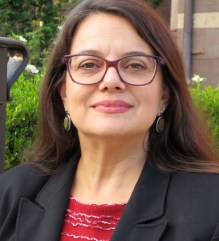
Featured Philosop-her: Nomy Arpaly

Nomy Arpaly

Nomy Arpaly is a professor of philosophy at Brown University. She received her PhD from Stanford University in 1998. She has written extensively on moral psychology including her book Unprincipled Virtue in which she argued that philosophers make a serious error in failing to see that there are good people with bad principles and fairly rational people who think they are not. Her most recent work includes “Deliberation and Acting for Reasons” (with Timothy Schroeder), In Praise of Desire (with Timothy Schroeder), “Duty, Desire, and the Good Person – Towards a Non-Aristotelian Account of Virtue”, “Huckleberry Finn Revisited: Inverse Akrasia and Moral Ignorance”, and (forthcoming) “Moral Worth and Normative Ethics”.

Some of my Recent Work, or Shameless Self-Promotion: Not Just for Male Philosophers Anymore!

Nomy Arpaly

Thank you, Meena, for having me over on your blog. I am going to take this opportunity to introduce some of my work, ending with work in progress, if you can call it that. I will first explain why you absolutely should read my recent book with Timothy Schroeder, and maybe a related paper or two. I will then say a few words about my current philosophical obsessions, for I am getting, with trepidation, into normative ethics. I am not a Kantian, or a utilitarian, nor even, despite rumors, a virtue ethicist. I want to make up another view one day, but for the moment I am just trying to lay the ground for one.

As a student of mine sweetly put it, In Praise of Desire is pretty “action-packed”, so I will not attempt a synopsis. Instead I shall attempt something more like a movie trailer. Our book is meant to show that a picture of moral agency (and human agency in general) in which all important motivation comes from desire, where desire is a non-cognitive state, can do justice to the incredible complexity of moral life. I’ll now go over (most) topics we touch upon under three headings: ethics, reasons and rationality, desire/love/addiction. I will also mention related work on responsibility and moral ignorance.

Ethics: we argue that, contra Kant, the morally worthy person does not act out of a special motive called duty but out of an intrinsic desire (for the right or the good. But why does it feel like duty? We talk about that, too). We argue that, that, contra Aristotelians, virtue consists not of having wisdom but of having the right intrinsic desire or desires.

I must mention that I have recently developed and made explicit much of what we think about the motive of duty in a single-author paper called “Duty, Desire, and The Good Person: Towards a Non-Aristotelian Account of Virtue”. My attempt to explain why, exactly, we feel a sense of duty even though we always act on desire is summed up in 800 words here. I would love some Kantian feedback on the view and the above-mentioned paper.

Some of my anti-Aristotelian thoughts, as well as a short version of our account of virtue, are also developed in the above-mentioned paper, and recently I have been fascinated, in a related way, by the relationship between virtue and such conditions as low intelligence and autism. Some of this can be found here.

Back to the book: we give a detailed account of virtue and vice, including their relation to cognition – why virtuous people typically have different cognitive attitudes despite virtue being about desire – and even to dreams. Also accounts of some particular virtues and vices (modesty, closed-mindedness and prejudice). We defend my old contention that people with terrible views of morality can nonetheless be good people. We also attempt to provide some insight into the nature of blameworthiness and thus touch on moral responsibility.

Reasons and Rationality: we argue that contra people as diverse as Korsgaard and Dancy, our ability to act and think for reasons is not grounded on deliberation, nor does it depend on the ability to regard something as a reason. Deliberation is an action that is sometimes done rationally and sometimes not. Most of the time when we act for reasons we don’t deliberate at all – that includes sophisticated actions like intellectual conversation – and no, it’s not that we used to deliberate about these things and now are just skilled enough to do them fast! Our deflationary view of the value of deliberation is defended to some extent in our “Deliberation and Acting for Reasons”. We ask: if deliberation is not the basis of acting for reasons, what is it for? And hopefully we answer.

We also argue extensively that the good old belief-desire theory of acting for reasons isn’t dead yet (while some philosophers who wish to believe that they are still young and rebellious refer to belief-desire theory as “the standard theory” before attacking it, the theory has been sneered upon for decades, and it is up to rebellious youngsters to defend it again). The nature of believing for reasons becomes relevant there as well.

Desire, Love, Addiction: in addition to all that, we talk about love and caring (defending desire-based accounts of love from the dismissive treatment they receive from some), about addiction (explaining why being a Humean does not mean that it’s rational for a cocaine addict to pursue cocaine) and, last but not least, we provide a theory of what desire is. We think seeing desire as a disposition to act is simplifying it a lot, and desire should be studied as a thing, a natural kind, that causes dispositions to act (though not all such dispositions – there are other things like habit), and also causes dispositions to feel (as when we are happy to get what we desire) and some cognitive dispositions (for example, if I strongly desire to talk to you, I am much less likely to forget your phone number that I didn’t write down). What is the thing that causes all these dispositions? Our answer, as well as our treatment of the nature of addiction, is grounded in the nature of the human brain. Tim brings a lot of neuro-scientific knowledge to the relevant chapters, but the text of these chapters has been tested on humanities types such as myself and revised and tested again until it was pronounced clear.

Related Stuff on Moral Responsibility: on my view, moral ignorance does not excuse. I just came out with a paper arguing for this called “Huckleberry Finn Revisited: Inverse Akrasia and Moral Ignorance”. It’s in an anthology called The Nature of Moral Responsibility. The paper contains an updated and intense defense of the view that there is nothing good about concern for morality de dicto. De re is where it’s at. Moral expertise is also touched upon.

Towards Normative Ethics

Currently, I am working towards a view according to which morality has a justice or fairness component and a benevolence component that are not reducible to one another or to anything else. Moral duties might be possible to index – I am not going for incomparability or particularism – but there is no one thing, such as Kantian universalizability or the principle of utility, on which both duties of justice and duties of benevolence are based. I don’t have a detailed positive theory yet, but I am arguing for the general conclusion. 

I have a paper I am very, very excited about coming out in Oxford Studies in Normative Ethics. It’s called “Moral Worth and Normative Ethics”. In it, I argue from premises about moral worth (dipping into my theory thereof in Unprincipled Virtue) to the conclusion that the truth about normative ethics is pluralistic.

On the way to that conclusion, I have to disagree with Kantians about the moral worth of some actions performed out of sheer concern for someone’s wellbeing. Kantians tell you that a helping action for which the agent deserves esteem is motivated by something like the thought “how will I fare in a world in which nobody helped anyone”, but I argue that the person who does not think about her needs at all and simply cares about the other person’s wellbeing can be esteem-worthy. This is not a reason-vs.-emotions argument because the concern for a person’s wellbeing can be quite dispassionate, whereas concern for universalizability can be quite passionate. I then concede that there are many cases in which considerations of wellbeing are overridden by other considerations, of a more Kantian nature, and so cannot be all there is to morality: but I also show that a person who lacks a sensitivity to considerations of wellbeing is missing something morally even if she is sensitive to universalizability. This is of course quite a short and simplistic summary of what I hope is a more complex discussion.

I am now working on resisting the Kantian idea that considerations of wellbeing can be re-described as considerations involving taking on other people’s ends. I would like to argue that benevolence – concern for other people’s wellbeing – cannot be replaced with concern for other people’s ends as an attitude that a moral person has. People’s ends often conflict with their wellbeing, and in such cases we are required to respect their ends, but also, in many cases, to wish for their wellbeing. I would be delighted to get any feedback on this stuff, especially from Kantians, so ask me about it if you feel like it!

Featured Philosop-her: Josefa Toribio

Josefa Toribio

Josefa (Pepa) Toribio joined ICREA (Catalan Institut of Research and Advanced Studies) in 2009 and is currently an ICREA Research Professor at the University of Barcelona. Pepa Toribio got her PhD from Complutense University, Madrid, in 1988. She worked as an Assistant Professor in the Department of Logic and Philosophy of Science at Complutense University between 1989 and 1991. She was then awarded a postgraduate fellowship by the British Council to work in the School of Cognitive and Computing Sciences at the University of Sussex (1991-1993). She was Assistant Professor at Washington University in St. Louis (1993-2000), Lecturer in Philosophy in the School of Cognitive and Computing Sciences at the University of Sussex (2000-2002), Associate Professor at the University of Indiana, Bloomington (2002-2004), and Senior Lecturer at the University of Edinburgh (2004-2008). She is a member of the research group LOGOS (Research Group in Analytic Philosophy) at the University of Barcelona. Since September 2010, she is also president of the Spanish Society of Analytic Philosophy (SEFA).

Experiencing, judging, believing

Josefa (Pepa) Toribio

A big thanks to Meena for running this fantastic blog and for inviting me to contribute to the series.

My goal in philosophy has long been the same: to explore the nature of the mind within a naturalistic framework. What is most distinctive of my research is my on-going effort to respect scientific findings about mental phenomena while insisting on the critical importance of the method of analysis and the theoretical tools provided by philosophy. I thus try to balance the two factors and to develop a fully integrated approach where each informs and constrains the other. In research, this enables me to pursue an agenda that tackles questions that the very best current scientific accounts leave unanswered. In teaching, it enables me to draw upon many traditions and to make contact with students whose inclinations are social and humanistic, as well as with those with those of a more standardly scientific persuasion. I believe strongly in the importance of this kind of balance.

My intellectual trajectory began with a dissertation about realism and anti-realism in semantics. The dissertation was in part a reflection on some of Michael Dummett’s ideas about the plausibility of characterizing certain metaphysical theses in semantic terms. Soon, what started out as an interest in the metaphysical commitments underlying the notion of truth in certain theories of meaning, morphed into an interest in the empirical and computational aspects of the architecture and the content of mental representations. I became more and more interested in those aspects of cognition that, while being rationally responsive, are not explicitly represented or consciously driven.

My current research focuses on the complex relations between perceptual experiences, beliefs, and mental actions, and covers two different but related topics: (i) the structure and nature of the content of perceptual experiences, and (ii) the nature of mental actions and how they relate to agency. I’ll say a little bit about the kind of work I have done within these two different but closely related areas. I’ll do it in reverse order.

When considering the things that we do, albeit mentally, the list uncontroversially contains mental actions such as imagining, calculating, deciding, reasoning or trying. It is more debatable whether or not judging should also be added to this list. As opposed to those who think that judging is involuntary and hence not an action, I press for the view that judging is a type of mental action and argue that judging is specifically a type of non-voluntary mental action. My account of the non-voluntary nature of the mental act of judging differs, however, from standard non-voluntarist views, according to which ‘non-voluntary’ just means regulated by epistemic reasons. In addition, judging is non-voluntary, I contend, because it is partially constituted by the exercise of a skill whose cognitive scaffolding often remains rationally opaque to the subject. This skill, which I call ‘critical pop-out’, consists of an unreflective, often unconscious, ability to detect the kind of situations in which the reflective abilities that also partially constitute our acts of judging should be deployed.

The main problem with standard non-voluntarism about judging, I argue, is that responsiveness to reasons is all they appeal to in explaining why our judgments make us objects of assessment. Responsiveness to reasons, and our answerability for such reasons, are the core of their agential view of judging. Yet, agency, I contend, runs deeper than rationality. This is particularly clear in our noticing or failing to notice those situations that demand the deployment of the rational abilities we exercise in judging. Such patterns of awareness reflect the kind of epistemic agents we are and thus make us worthy objects of epistemic assessment. They are shaped essentially by our education, socialization, friendships and the like. What matters for the critical pop-out constituent of the act of judging to count as agential is that we are indeed held responsible for this ability—the ability that makes us select certain parts of the world around as deserving of our rational engagement.

Philosophy of perception is really the core of my research. Over the years, I have defended a representationalist view of the content of perception and have endorsed a non-conceptualist view about the content of perceptual experiences in a series of papers. The notion of personal-level non-conceptual content at issue here has to be understood along the lines of the original proponents of the idea. For any perceptual experience E with content C, C is non-conceptual if and only if C is essentially different in kind to the content of beliefs, where, importantly, the content of beliefs is characterized in neo-Fregean terms. A different formulation of the notion of non-conceptual content, also commonly found in the first papers on non-conceptualism reads as follows. For any perceptual experience E with content C, any subject S, and any time t, C is non-conceptual if and only if it is not the case that in order for S to undergo E, S must possess at t the concepts that a correct characterization of C would involve.

On the first (content) view, perceptual non-conceptualism is a thesis about the kind of content perceptual experiences have. On the second (state) view, perceptual non-conceptualism is a thesis about the relation that holds between a subject undergoing a perceptual experience and its content. It may thus seem consistent to hold that both perceptual experiences and beliefs share the same (conceptual) content, but that for a subject to undergo a perceptual experience, the subject need not possess the concepts involved in a correct characterization of such content. Let’s call this thesis T.

I have argued against T along the following lines. First, I show how T’s consistency is only possible once we abandon the neo-Fregean contrastive notion of conceptual content discussed by the original players in the debate. According to this neo-Fregean characterization, conceptual content is composed of concepts, which are, in turn, understood as abstract ability-types. There is nothing more to the nature of those ability-types than their instantiation in the form of the set of abilities that a subject exercises when she entertains thoughts containing that concept. Second, I argue that abandoning this neo-Fregean approach to concepts and concept possession threatens content attribution, i.e., threatens the necessary link between the ways a subject takes the world to be and her relevant cognitive abilities—those that need to be invoked to explain the subject’s intentional behaviour. Yet, if we were to keep it, T would become incoherent, as it entails that a subject could exercise cognitive abilities that she does not possess. When the contrastive notion of conceptual content is construed in the relevant neo-Fregean terms, I argue, state and content view are nothing but the two sides of the very same thesis. This line of argument also allows me to stop the attempt to use T’s alleged consistency to show that the form and core of the conceptualism/ non-conceptualism debate is undermined or ill conceived.

My work also touches on issues relating to the relationship between perceptual non-conceptualism and some empirical theses, such as the thesis of the cognitive empenetrability of early vision. I have argued against the view that the (alleged) cognitive impenetrability of early vision states is a necessary and sufficient condition for their content to be non-conceptual—the mutually entailing thesis, as I call it. Even if we grant that that the property of being non-conceptual admits two different interpretations—corresponding to the distinction between the state and the content views as formulated above—the mutually entailing thesis fails. I first argue for the falsity of the state-non-conceptualist reading of the thesis on the grounds that it mistakenly takes being non-conceptual to be a causal instead of a constitutive relationship. The content-non-conceptualist understanding of the thesis, I then argue, is disproved by plausible views regarding the content of experience. The mutually entailing thesis could only be true, I contend, on a non-standard, causal interpretation of the notion of nonconceptual content. Yet, on that reading, the thesis would either be trivially true or would entirely fail to engage with the contemporary literature on perceptual non conceptualism.

Finally, in my most recent work, I explore the relation between the alleged richness of the content of perceptual experience and the idea that perceptual experience is cognitively penetrable by background states, such as beliefs, desires or emotions. According to so-called “thin” views about the content of experience, we can only visually experience low-level features such as colour, shape, texture or motion. According to so-called “rich” views, we can also visually experience some high-level properties, such as being a pine tree or being threatening. One of the standard objections against rich views is that high-level properties can only be represented at the level of judgments. I have recently offered rich theories a plausible escape route from this objection based on some recent studies in social vision. I have also tackled a different but related issue, namely, the relationship between rich views and the view that visual experience is cognitively penetrable. Despite their logical independence, both theses tend to go hand in hand in the literature. I argue, however, that the very criterion that establishes the genuine visual nature of our representations of some high-level properties makes the entailment from rich views to cognitive penetrability problematic.

The nature of the content of the mental states involved in paradigmatic cases of implicit bias has emerged lately as a key platform to carry on thinking and writing about issues in this vicinity. What all these threads have in common is that they arise at the barely-explored intersection between scientifically-informed philosophy of mind / cognitive science and what might be dubbed the ‘normative image’ of mind, according to which a proper account of the mental cannot be developed without attention to matters concerning value, ethics and responsibility.

Featured Philosop-her: Lisa Rivera

RiveraLisa

Lisa Rivera is Associate Professor Philosophy at University of Massachusetts, Boston. Her research is primarily in the area of moral and political philosophy. Her work in ethical theory considers whether moral theory must be impartial, the moral philosophy of Bernard Williams, the scope of moral demands, whether beneficence can be harmful to free agency, captivity and coercion and how voluntarily assumed commitments to promote justice can obligate us. In political philosophy she has published on political liberalism, and the responsibility of citizens for unjust war. She is currently working on the moral responsibilities raised by political membership and the relevance of emotions for political theory. She is the current chair of FEAST (Feminist Ethics and Social Theory) and the Director of Philosophy in an Inclusive Key-Boston (PIKSI-Boston).

Ethical Theory and Social Context

Lisa Rivera

Most of my papers in ethics start with the idea that social context is relevant to foundational questions in normative theory. You might say this is a type of stealth project. I’ve only once made a direct claim about social location in an ethical theory paper. So perhaps this blog post is a confession that I think issues about social context are buried within a lot of the questions moral philosophers ask about impartiality, universality, responsibility and obligation. I thank Meena for allowing me the chance to come clean about my terrible secret on this excellent blog of hers.

It’s clear that people’s circumstances and their relations with other people generally have normative import for them. To whom do they answer? What are their personal or political commitments? What structures or communities are they benefitted or burdened by? To whom or what are they expected to be loyal? Who depends on them and whom are they dependent upon? What do they think makes their life worthwhile. Should we reject these as relevant, try to fit them within our theories, or give up looking for a systematic moral theory?

To reminisce a bit–when I was a novice and semi-fanatical convert to philosophy, I would wonder if I should adopt, and then live by, one of these ethical theories. Students sometimes get this idea and then become perplexed about how anyone can make use of the theory in practical situations. My youthful uncertainty that I could apply these theories in real life situations was doubtlessly influenced by the way normative theory is sometimes taught–especially at UC Berkeley in the late 1980s, when Bernard Williams was right down the hall. Back in the hippie days, counterexamples circled normative theories like buzzards. Many of these were of the form “impartial theory T says that A should do y–e.g., benefit a bunch of other people–but y competes with z, e.g., a life goal such as being a great artist. We all know that it’s hard to just ignore z no matter how much T says y is the right thing to do.” So Stocker’s moral schizophrenia, Wolf’s moral saints, Blum’s arguments about friendship, and Williams’ integrity example take this form. The ideal of impartiality was challenged by the observation that there’s an essential aspect of human life that will necessarily compete with impartial moral considerations. Can we be the best person impartiality can make us and still be a good friend/husband/cool/witty/a gourmet cook?

These objections were quickly met with at least three kinds of arguments: Maybe z (thing we’re partial to) isn’t so important compared to the impartial demand raised by T. Or maybe a revised version of T accommodates z in some way hitherto before unnoticed. Or maybe a better understanding of T will show z wasn’t a problem after all. A rarer option at the time was to deny that the normative theory in question was action-guiding, i.e., to make T a purely indirect theory.

If one takes the second route and accommodates z in the theory, it will usually look as if there is a thicket of considerations one must navigate through while still being guided by the light of some impartial moral perspective. For example, if you follow Railton’s solution to the alienation that consequentialism might cause, you have to figure out the diverse list of goods that count as best consequences, then develop the type of character likely to promote those goods indirectly, and then do all this counterfactually without constantly checking your actions to see if they are promoting the goods on your list. The Kantian strategy is different, but Barbara Herman notes that moral agents need to use rules of moral salience to grasp complex features of moral situations.

This level of complexity to successful moral choice can lend itself to the suspicion that there’s a lot more to successful moral action than following moral principles. I used to joke with a friend that I would someday write a pop culture book called ‘Why Are People So Bad?’ to explain why it so common that–even when we intend to do the right thing–we botch it. The usual suspects for our moral failures are motivational or cognitive. But beyond this, it certainly looks as if some moral agents are more competent than others. As Julia Annas puts it, you couldn’t give even a very smart teenager a moral manual and expect them to bat 1,000 morally. Some claim success is due to moral character–the ideal sometimes referred to as practical wisdom in the form of the virtues. However, attention to social context also provides a puzzle piece for those who want to understand the complexity of moral choice.

An example where social context is relevant to choosing well is beneficence. Ordinarily, we imagine we can benefit a person by giving them what they want. There’s nothing paternalistic about helping people get what they themselves choose. And a lot of people think that if you give a person what they absolutely need for their physical survival you almost can’t go wrong, morally speaking. How could you go wrong if you gave a poor person medical care? As it turns out, though, benefactors go wrong all the time in these situations. Sometimes humanitarianism is a disaster for its recipients, even when providing basics like food, water, and medical care. I call this problem “harmful beneficence.” How do we account for what benefactors did wrong? A main explanation is that, while they manage to meet people’s ends–e.g., by keeping them from dying of a sickness they currently have– they used means to that end that collided with other values and ends of beneficiaries, –e.g., they set up a hospital that increases colonialism’s hold over a community trying to resist colonialism. A benefactor can meet a beneficiary’s need while also destroying resources she depended on for her future free agency. The benefactors do not realize the problems they are causing because people’s ends are nested in a complex conception of their good that the benefactors don’t fully understand. This is likely to happen when there are significant imbalances in social power between people, and their social locations are very far apart. We can hope people are benefitted to some degree, but because free agency is undermined, we need to do better.

People’s social context can also give them a deep sense of obligation falls outside or pulls them away from the standard view in ethical theory of what they are obligated to do. I’ve defended Bernard Williams’ point that it is very difficult to systematize moral choice and leave nothing normatively relevant behind. Moral theory is a Procrustean bed. His concerns about integrity can be read as a defense of our investment in the part of us moral theory wants to cut off, e.g., a project or a commitment around which we’ve based the meaning of our life.

One spin on this concern makes it look easy to dismiss. Satisfying a moral demand can involve a loss. Someone might say “what’s the big deal? It’s hard to be good but that’s no reason not to make the moral sacrifice.” One way to salvage Williams’ idea is to point out that competitors to moral requirements can be life goals with undeniable normative pull. One such competitor is a moral sacrifice that falls outside the bounds of what the normative theory requires. So someone might believe an injustice is so terrible that she should risk her life to remedy it, as the Mirabal sisters did in resisting Trujillo’s dictatorship in the Dominican Republic.  Political activity to resist Trujillo was non-optional for them. A second type of normatively compelling consideration is a voluntarily assumed political commitment that arises out of social location. So a person from a racially oppressed group may take up an activist project on behalf of her group or a wealthy American may believe they have to take up global justice activism. Moral theory permits people to pursue such commitments but our current theoretical apparatus can’t show why these commitments aren’t fungible with other commitments. And they fail to explain their normative pull.

Recently, I’ve been trying to turn this approach around and look at how personal and interpersonal normative expectations can push or pull us socially and politically. What is the relevance of the interplay between the people we are supposed to be within a society and political theories about how we should organize society? I’m considering ways that political emotions drive us to make normative claims on ourselves and others, such as the insistence Americans should be proud of our national identity. Emotions of self-assessment such as pride, shame and guilt are particularly relevant to showing how we engage with other members of the polity and they give us powerful incentives to embrace or reject, and benefit or harm those we share a society with.

Featured Philosop-her: Anne Eaton

eaton

A.W. Eaton is an Associate Professor in the department of philosophy at the University of Illinois at Chicago. She received her Ph.D. from The University of Chicago in both philosophy and art history in 2003. She works on topics in feminism, aesthetics and philosophy of art, value theory, and Italian Renaissance painting, including: the epistemological and ontological status of aesthetic value, the relationship between ethical and artistic value, feminist critiques of pornography, representations of rape in the European artistic tradition, and artifact teleology (for more details and publications, see her homepage). Anne was a Laurence Rockefeller Fellow at Princeton’s Center for Human Values in 2005-6. She is currently the editor of the Aesthetics & Philosophy of Art section of Philosophy Compass.

Taste and Social Injustice

A.W. Eaton

It is an honor to contribute to this excellent blog. Meena, thank you for your hard work in keeping this going for us!

Before I tell you about my work, I want to say something about my field. I’m a feminist philosopher whose primary home is in aesthetics/philosophy of art (I’ll say just “aesthetics” for short). One of the things that you might not know about aesthetics is that we can boast of an unusually high (for philosophy, that is) percentage of women. It’s also a field where there are a lot (again, compared to other fields in philosophy) of highly respected senior women. For instance, the current president of the American Society of Aesthetics is Cynthia Freeland (U. Houston) and the next president will be Kathleen Higgins (UT Austin), and there have been several other women presidents in the past 10 years. Aesthetics has provided me with multiple women role models and lots of women friends, and our annual conference is one where I generally feel like my gender presentation is not a liability (at least compared with, say, the APA). I sometimes wonder if our relative woman-friendliness is part of the reason that aesthetics is not taken as seriously by philosophers from other fields. Who knows? What I do know is that while aesthetics is not perfect, it’s a relatively good place to be a woman compared with other parts of philosophy I’ve seen. (On both the bad and the good in aesthetics, see Sherri Irvin’s excellent blog post here.)

Philosophy-wise, aesthetics has a lot to offer feminism. One example is a topic I’ve recently been working on, namely taste. In particular, I’m interested in what I call taste in bodies, by which I mean, roughly, a person’s sense of what makes a person (herself or another) physically attractive or unattractive in some way.

Taste in bodies is a complex matter. For one thing, our taste in bodies takes as its object more than the body strictly speaking, and extends to: things that we do with our bodies, like kinds of bodily comportment; the way we care for and groom our bodies; and things that we put on our bodies, like clothing, makeup, jewelry and other accouterments. Further, physical attractiveness and unattractiveness have many modalities, of which “beauty” and “ugliness” are just two. Others include: handsomeness, cuteness, sexiness, chic-ness, cleanliness, tidy-ness, fragrance (pleasant smelling), on the one hand, and ugliness, dorkiness, dumpiness, repulsiveness, dowdiness, dirtiness, unkemptness, stinky-ness, on the other hand.

As you can probably tell from this (admittedly incomplete) list, taste is usually evaluative to some degree. By evaluative I do not mean that taste need involve explicit appraisals of the worth of the object toward which it is directed; rather, I mean that the phenomenology of taste is to present its object as valuable and so worthy of experiencing, having, or preserving (or as disvaluable and so to be avoided or discarded). This is one way that taste can be so important for feminism and other fields centered on oppressions that are at least in part bodily, such as ableism, racism, fatism, and trans-negativity. Whether we are consciously aware of it or not, certain types of bodies, bodily features, manners of bodily comportment, and ways of decorating and accessorizing bodies are pervasively over-valued in our society; these strongly tend to be the bodies of relatively thin, able-bodied, cis-gendered persons racialized as white. On the other hand, bodies that do not fit this aesthetic paradigm – especially, but not exclusively, bodies that are trans*, fat, disabled, or belonging to persons racialized as Black – are chronically devalued and derogated.

Some people might think, “Ok, so features that typify members of oppressed groups are considered less attractive than features that typify members of privileged groups. Still, physical attractiveness is such a superficial matter. Shouldn’t we concentrate on things that really matter, like discrimination, poverty, and violence?”

My answer is that of course we should concentrate on these things. But we oughtn’t underestimate the role that perceived physical un-attractiveness can play in these things, or the extent to which perceived physical attractiveness and un-attractiveness have far-reaching moral, psychological, social, and economic ramifications. For instance, at one extreme of the spectrum of physical attractiveness, philosophers working in moral psychology have shown that judgments about bodily disgust have historically played and continue to play a pivotal role in demarcating and maintaining group boundaries by vilifying and dehumanizing a given out-group (women of all colors, Jews, Blacks, disabled persons, homosexuals, and trans* persons). And there is considerable evidence from social psychology that those perceived as merely unattractive or even just “plain” are not only less likely to be judged smart, interesting, and likeable than those deemed attractive; those perceived as unattractive are also more likely to receive unfavorable treatment in legal settings, less likely to be hired and promoted, earn on average lower salaries, and so on. All of this can have far-reaching, and sometimes quite severe, negative consequences for self-esteem and interpersonal relations; this is typically especially true for women. Finally, there is good evidence from social psychology not only that perceived physical attractiveness affects our unrelated assessments of ourselves and of others, but also that we strongly underestimate the extent to which this is so, making this kind of bias especially difficult to detect and dismantle.

In these and other ways, people’s taste in bodies does not merely reflect the dominant order (which is white, male, ablest, homo-negative and fat-negative and trans-negative); taste in bodies, I am arguing in my current work, is part of what promotes and maintains that order.

Now, contemporary feminist philosophy tends to eschew considerations of the role of taste in promoting and maintaining male supremacy (or whatever you prefer to call it). I think that part of this eschewal is due to a misunderstanding about taste, a misunderstanding that, for instance, Sally Haslanger expresses in her important essay ‘“But Mom, Crop-Tops Are Cute!” Social Knowledge, Social Structure, and Ideology Critique,’ when she worries that construing the claim “crop tops are cute” as a judgment of taste would not “make room for meaningful critique” (p. 73). But most any aesthetician will tell you that it is a mistake to assume that taste leaves no room for meaningful critique: contrary to the adage “De gustibus non disputandem est,” there is disputing about taste. For instance, we can ask whether our judgments of taste are properly directed at appropriate aesthetic properties. A different approach inquires into the morality (broadly construed) of our taste; for instance, we can critically ask whether our taste supports or undermines social justice.

Another reason for this eschewal of taste is feminism’s generally intellectualist tendency, by which I mean a tendency to conceive of sexism primarily in terms of peoples’ (misguided) beliefs about the two sexes (and, of course, the actions based on these beliefs).

While I of course do not disagree that false beliefs – both conscious and unconscious – play a significant role in sustaining the dominant order, I urge that we give more attention to the role of the affective life, and in particular more attention to taste, when thinking about various kinds of oppression. After all, on most any plausible account of human action, beliefs are not by themselves sufficient to motivate us to act.

On my view, finding crop tops to be cute, or high heels to be sexy, or fat to be unpleasant and maybe even disgusting, these are all a matter of what I’m calling taste in bodies. One feature of taste in bodies, as with all taste, is that it can be deeply norm discordant and unresponsive to rational guidance. (Just think, for example, about how effective you might be at arguing your way into finding a particular type of body or bodily feature to be attractive.) This is very important when considering taste’s role in sustaining various forms of oppression.

To see what I mean, let’s consider an example like high-heeled shoes. It is really and truly my deeply considered view that high-heeled shoes are bad for women in a variety of ways: e.g., whereas most men’s shoes are grounding, enabling, and relatively foot-friendly, high-heeled shoes are by contrast harmful to feet, legs, and back, and they are hobbling in the sense that they basically force us to take mincing steps and are difficult, if not impossible, to run in (and these effects are all more pronounced the higher the heel). To wear high-heels is to not only participate in, but also to promote, an aesthetic that diminutizes and sexualizes women. For these reasons, I think that we ought not wear heels, and one might give similar reasons against crop tops. (Just to be clear, I do not mean, of course, than anyone should be prohibited from wearing heels or crop tops, nor do I think that women and girls should be shamed or even criticized for wearing these things. But I do think that eliminating heels and sexually revealing clothing, which means eliminating the taste for these things, would be one important step toward achieving gender equality.)

But here’s the rub. While I am fully doxastically committed to this, I nevertheless own several pair of high-heeled shoes that I regularly wear. Why? I’m sure that you can guess: because I think that they make me look attractive and I care about looking attractive (more than I would like; which is yet another thing that I intellectually disavow on feminist grounds yet nevertheless perform and uphold in my daily life). Or, to put the point in a way that connects up with what I was saying earlier: because I have developed a taste for heels. And when it comes down to making decisions about what to wear, my taste often wins out over my well-considered convictions, and so I end up embodying and promoting something that I disavow. Even if you don’t agree with me about heels, I hope that you recognize the general phenomenon and can see why it’s important.

So this is the kind of thing I’ve been working on. I’ve recently finished a paper on fat negativity (for a terrific collection on bodies aesthetics edited by Sherri Irvin), where I consider the role of disgust and other negative aesthetic attitudes in maintaining fat oppression, and especially to the disadvantage of fat women (just to be clear, I use “fat” in a purely descriptive and non-judgmental way). And I’ve just started a paper that looks at the role of taste in maintaining a white supremacist hair aesthetic that derogates the many kinds of hair typically associated with persons racialized as Black – again, a phenomenon that hits women especially hard. And finally I’m working on a couple of papers on pornography that consider the ways that the dominant forms of porn function to mal-form their audiences’ erotic tastes in ways that maintain gender injustice.

In all of these papers, I’m also especially interested to think not just about how taste perpetuates oppressions of various sorts, but also to think about how we can bend our tastes in bodies in the direction of social justice. How can we change taste for the better? Since I’ve probably already gone on too long, I’ll just say briefly that I’m developing an Aristotelian answer, namely habituation. Habituation involves repeated guided exposure to the thing in question, where the point of the guidance is to ensure that the trainee, as it were, comes to see the value (or disvalue, depending on which way the habituation is going) in the thing to which she is being habituated. (This, by the way, is supposed to be the difference between Aristotelian habituation and mere operant conditioning.) Through habituation, one comes to develop the standing disposition to have the right sorts of pleasurable or displeasurable evaluative feelings about an object, and to have these feelings with the proper intensity; in other words, to develop the right sorts of tastes. I think of most advertising as working on this model. Vivid pictures (moving or still) entice their audiences to have evaluative sentimental responses to the objects they depict (which are the objects being promoted), and this directed engagement inculcates in the audience a predisposition to have the same kinds of response to similar objects in the world.

So that’s what I’m working on. Thank you for reading! I’d love to hear your thoughts!

Featured Philosop-her: Elizabeth Barnes

E Barnes

Elizabeth Barnes is Associate Professor of Philosophy at the University of Virginia. She works in metaphysics, social and feminist philosophy, and ethics, and is especially interested in the the places where these subjects overlap. Right now she’s finishing up a book on disability (The Minority Body) and thinking a lot about the metaphysics of social structure.

Confessions of a Bitter Cripple

Elizabeth Barnes

I didn’t expect to feel so angry. A few years ago, having established a certain amount of professional security, I decided to start doing more work on social and feminist philosophy – especially philosophical issues related to disability. I’d always done some work on the topic, but I considered doing lots of work on it a professional luxury that had to be earned. When I began to focus more of my research on disability, I expected plenty of things – a deeper sense of fulfillment from what I was doing, a fair amount of side eye from colleagues, worries that the topic was too niche to be of general interest – but I didn’t expect the emotional drain that the work would be. I feel angry – more than I could’ve anticipated and more than I often care to admit – when I write about disability. And I also, at times, feel so, so sad.

I have sat in philosophy seminars where it was asserted that I should be left to die on a desert island if the choice was between saving me and saving an arbitrary non-disabled person. I have been told it would be wrong for me to have my biological children because of my disability. I have been told that, while it isn’t bad for me to exist, it would’ve been better if my mother could’ve had a non-disabled child instead. I’ve even been told that it would’ve been better, had she known, for my mother to have an abortion and try again in hopes of conceiving a non-disabled child. I have been told that it is obvious that my life is less valuable when compared to the lives of arbitrary non-disabled people. And these things weren’t said as the conclusions of careful, extended argument. They were casual assertions. They were the kind of thing you skip over without pause because it’s the uncontroversial part of your talk.

Now, of course, no one has said these things to me specifically. They haven’t said “Hey, Elizabeth Barnes, this is what we think about you!” But they’ve said them about disabled people in general, and I’m a disabled person. Even just thinking about statements like these, as I write this, I feel so much – sadness, rage, and more than a little shame. It’s an odd thing, a hard thing, to try to take these emotions and turn them into interesting philosophy and careful arguments. My first reaction isn’t to sit down and come up with carefully crafted counterexamples for why the views I find so disgusting are false. My first reaction is to want to punch the people that say these things in the face. (Or maybe shut myself in my room and cry. Or maybe both. It depends on the day.) It’s a strange thing – an almost unnatural thing – to construct careful, analytically rigorous arguments for the value of your own life, or for the bare intelligibility of the claims made by an entire civil rights movement.

I’m now putting the very finishing touches on a book on disability, though, so that strange and unnatural thing is more or less what I’ve been doing for the last two years. My book is an attempt to show that the the kinds of things that often get said about disability within the Disability Rights Movement – that disability is a valuable part of human diversity, that disability is a social identity that disabled people should claim and be proud of, that many of the most significant harms of being disabled are social harms – have clear philosophical defenses and aren’t nearly as counterintuitive as many philosophers seem to assume. Writing this book has been one of the most eye-opening professional experiences of my life. The beginning of the process was also the period in my life when I had to transition from being mostly invisibly disabled to being mostly visibly disabled. So the last two years have been an incredible learning curve, to say the least.

One of the most difficult things I’ve encountered is that, while I feel so angry and so sad about the subject matter, I have to work hard – especially now that I am visibly disabled – to not seem that way. A few ironic jokes are fine. But real anger and sadness? That has to be kept hidden away. And that’s because one of the biggest challenges to having my work on disability taken seriously is the worry that I am too ‘personally invested’ in the topic. And seeming emotional can only amplify those worries. Don’t get me wrong, I think those worries are absurd. I am personally invested in the topic of disability. Of course I am. But the last time I checked, most non-disabled people are also rather personally invested in the topic. That is, non- disabled people are personally invested in being non-disabled just as much as I am personally invested in being disabled. Disability – or lack thereof – is something everyone takes personally. And I don’t think that’s a bad thing, or something that impedes good philosophy. But the simple fact is that my work will be seen as personal in a way that Peter Singer’s or Jeff McMahan’s won’t.

The other pitfall in expressing emotion – especially negative emotions like anger or sadness – when talking about disability – again, especially if you are visibly disabled – is that people always misinterpret you, no matter how explicit you are. You are read as a ‘bitter cripple’ or a ‘sad cripple’. And of course you’d be angry or sad – look at what happened to you! (Readers should please picture me rolling my eyes deeply at this point.) It’s a surprisingly difficult thing – sometimes it’s an impossible thing – to explain to people that you are not angry and sad about your disability, you are angry and sad about what is being said about your disability or how you are being treated because of your disability. You can say that as loud, as often, and as clearly as you want – people will still interpret your anger and sadness as the natural result of the bad luck you’ve had in life. Again, hiding the anger and the sadness is the easier way to go.

But what I’ve been learning – in baby steps – is to try to channel my emotions into better philosophy. I’m trying to figure out how to use my anger and my sadness as motivation to make my work better, and I think – at least sometimes – that it’s working. (Obligatory shout-out here to Audre Lorde and Alison Jaggar on the value of outlaw emotions.) Sally Haslanger once told me to trust my anger. That was some of the best advice anyone’s ever given me. I’m trying to learn how to take my anger and use it as motivation to keep writing, especially on those days when the thought of using philosophical arguments to push back against the status quo feels somewhere between overwhelming and pointless. And while feeling this way can be exhausting – in a way that writing about, say, metaphysical indeterminacy never was – it can also make the end result deeply special and meaningful in a way I wouldn’t have anticipated.

Featured Philosop-her: Susanna Schellenberg

Susanna Schellenberg

Susanna Schellenberg is an Associate Professor at Rutgers University. She has published articles on perceptual experience, evidence, capacities, Fregean sense, action, mental content, and imagination. Her work has been published in journals such as The Journal of Philosophy, Mind, Noûs, and Philosophy and Phenomenological Research. Before moving to Rutgers, she was at the Australian National University, where she was the first woman to be hired in a permanent position in the School of Philosophy at the ANU’s Research School of Social Sciences. 

Perceptual Experience is Fundamentally a Matter of Employing Perceptual Capacities

A big thanks to Meena for initiating and running this excellent blog. And thanks also for inviting me to contribute a post.

Perceptual experience plays at least three different roles in our lives. It justifies our beliefs about our environment. It brings about conscious mental states. It converts informational input, such as light and sound waves, into representations of features that we attribute to the world. Corresponding to these three roles, there are at least three fundamental questions that have motivated the study of perceptual experience.

Epistemology-question: How does perceptual experience justify our beliefs and yield knowledge of our environment given that perceptual experience can be misleading (we may be subject to illusion or hallucination)?

Mind-question: How does perceptual experience bring about conscious mental states in which our environment appears or seems a certain way to us (irrespective of the way our environment actually is)?

Information-question: How does a sensory system accomplish the feat of converting varying informational input into mental representations of invariant features that we attribute to the world?

The last decade has seen an explosion of work in philosophy of mind and cognitive science addressing the mind- and information-questions. While there has been fruitful interaction between work on perception in philosophy of mind and cognitive science, there has been much less attempt to integrate this work with issues in epistemology. Theories that are motivated by the mind- and information-questions have to a large extent been developed independently of concerns about how perception provides us with evidence and knowledge of our environment. For the same reason, theories of perceptual experience that are motivated by the epistemology-question have been developed largely independently of concerns about how perceptual experience brings about conscious mental states. To be sure, most accounts of perceptual justification rely heavily on the idea that perception yields sensory states, which justify beliefs. However, such accounts typically take as a given that such sensory states provide evidence and immediately proceed to addressing the question of what the relationship is between the evidence provided and relevant beliefs.

There is an increasing recognition that this split has hindered a good understanding of perceptual experience. Questions in philosophy of mind are intimately connected with questions in epistemology in particular with regard to perceptual experience: arguably the role of experience in yielding sensory states is not independent of its role in justifying our beliefs and yielding knowledge. If this is right, then perceptual experience should be studied in an integrated manner.

I am currently working on a book project in which I develop a unified account of the epistemological and phenomenological role of perceptual experience. In a series of papers, I have developed a representationalist view of perceptual experience and perceptual particularity that lays the groundwork for this view. One of the key ideas in developing this account is that perceptual experience is a matter of employing perceptual capacities.

I argue that experience provides us with evidence in virtue of its metaphysical structure. More specifically, I argue that sensory states are yielded by employing perceptual capacities that function to single out particulars in our environment. So there is primacy of the employment of perceptual capacities in perception over their employment in hallucination and illusion. Due to this primacy, sensory states provide us with evidence. This view of evidence is externalist while avoiding the pitfalls of reliabilist accounts. Moreover, it provides for an evidential answer to how and why we are in a better epistemic position when we perceive than when we hallucinate (Mind 2013 and Philosophical Studies 2014, 2015). The more general project is to ground intentional states in the employment of mental capacities and to explain the epistemic force of the intentional states in virtue of properties of the capacities employed.

This view of the epistemic force of perceptual experience is grounded in a representationalist view of perceptual experience. I have defended a detailed account of the nature of perceptual content that advances a new way of understanding singular modes of presentations. I argue that experience is fundamentally both relational and representational (Philosophical Studies 2010, Noûs 2011). This view of content has interesting implications for the sensory character of experience. It provides for a way of understanding sensory character in terms of a mental activity, more specifically, in terms of employing perceptual capacities (Philosophy and Phenomenological Research 2011).  The idea is that in hallucination, we employ the very same perceptual capacities that in a subjectively indistinguishable perceptual experience are employed as a consequence of being related to external, mind-independent objects or property-instances. Employing perceptual capacities yields a mental state with content. This representational account of sensory character is an alternative to the orthodox approach on which sensory character is analyzed in terms of awareness relations to abstract entities, such as properties, sense-data, or other peculiar entities. By arguing that we employ the very same perceptual capacities in subjectively indistinguishable perceptions, hallucinations, and illusions, I provide a metaphysically substantive way of understanding the common factor between these experiences.

Other focuses of my research has been space perception (Mind 2007), the situation-dependency of perception (Journal of Philosophy 2008), and the relationship between belief and desire in imagination (Journal of Philosophy 2013).

Selected Publications:

“Phenomenal Evidence and Factive Evidence”. Symposium with comments by Matt McGrath, Ram Neta, and Adam Pautz, Philosophical Studies.

“The Epistemic Force of Perceptual Experience”. With a response by Alex Byrne, Philosophical Studies 170 (1), 2014, pp. 87-100.

“Belief and Desire in Imagination and Immersion”, Journal of Philosophy, 110 (9), Sept. 2013, pp. 497-517.

“Perceptual Content Defended”, Noûs, 45 (4), Dec. 2011, pp. 714-50.

“Ontological Minimalism about Phenomenology”, Philosophy and Phenomenological Research, 83 (1), July 2011, pp. 1-40.

“The Situation-Dependency of Perception”, Journal of Philosophy, 105 (2), Feb. 2008, pp. 55-84.

“Action and Self-Location in Perception”, Mind, 116 (463), July 2007, pp. 603-32.


Featured Philosop-her: Denise James

DeniseJames


Denise James is assistant professor of philosophy at the University of Dayton where she facilitates the Diversity Across the Curriculum program. She teaches courses in contemporary social and political philosophy. She is currently working on a monograph about urban divestment and the possibility of justice in U.S. cities in a post-industrial age from a pragmatist perspective. She has published on the intersections of classical American pragmatism and black feminist philosophy. One of her latest projects is on the radical habits of Angela Davis and John Dewey.

Dying Cities and Useful Doctors

Denise James

Thank you, Meena, for the invitation and for maintaining such a great series. As I’ve followed along, I’ve been really enthralled with how people are describing how they came to their current projects. With that I mind, I hope my conversational contribution here is both appropriate to the invitation and interesting to the readers of the blog.

August 5, 2008

August 5th is my birthday and on that day in 2008 I was a brand new resident of the city of Dayton. I’d move to the city to begin my job at the University of Dayton and knew next to nothing about the town or the university. I woke up to happy birthday wishes from friends and family far away from my loft in downtown Dayton on social media. Everyone wanted to wish me good luck on my move and new job. One great friend also left a link with her well wishes. Forbes magazine had posted an article about “America’s Fastest Dying Cities,” my new city had made the list, along with three other cities in Ohio.[1] In the days that followed new colleagues posted the local response to the Forbes article and old friends wrote, called, and messaged to inquire about the viability of my new city.

Was Dayton dying? Could a city die? What did that mean for the people who lived there?

As a black feminist pragmatist philosopher interested in questions of social justice, political geography, and subjectivity, the dying city posed a series of problems for me that I could not get away from as hard as I tried to that warm August birthday the month before my first job post grad school was set to begin. I spent that day reading at the picturesque Riverscape Park that I was just a few blocks from where I lived and made plans to hang out with new friends at a local night spot. During a friendly tour of one of the city’s historic neighborhoods and over watery drinks at the club, the pending death of Dayton was the choice topic of conversation.

Friends I’d met in my building, most of whom were black and had grown up in the city, seemed to agree, the city was dying. Downtown, where we lived, had not become the great mecca of urban professionals the developers of our loft building had hoped. There was no close grocery store to us and in spite of some swank restaurants and the beloved minor league baseball team’s stadium being in walking distance, downtown had suffered the losses in population and industry as hard as the rest of the city. Vacant housing and businesses were the norm not the exception. Unemployment and homelessness were high. We talked about failing school districts and the paring down of government services.

Friends associated with the university were almost univocally convinced that the city, although it was experiencing population decline and had lost most of its major manufacturing employers, was not dying. They pointed out that local health networks, the U.S. Air Force base, and our employer, the private Catholic university, were all thriving. There were plans! The city would be restored.

In the coming months and years I would sit in audiences and attend meetings where members of the city council and university related officials would talk about all of the ways Dayton was not dead or dying, all of the ways it would be restored to full health. Local news, radio, and print media ran stories about efforts citizens and businesses were making to rethink what Dayton would be as a city. And all the while I wondered, sometimes aloud, if perhaps the city was being remade with the needs and aspirations of the current residents in mind. It seemed a lot of the efforts, both rhetorical and strategic, focused on attracting new residents to the city and not necessarily on how those efforts would affect those inner city, poor and working class, people who lived there. It seemed lots of people were just assuming that the influx of new residents would have a helpful, trickle-down effect on the old.

I started thinking about how many of these conversations posited as ideal, types of citizens who lead types of lives that didn’t seem to match the people who I knew and encountered every day in Dayton. Many of these people were not the newly unemployed but had experienced job loss decades before. Generational poverty, inadequate housing, and a city with a history of segregation that still marks the sides of town as white and black are the context of many peoples’ lives in this city and many others. Plans to open the city to new migrants and revitalize by being a mecca for small manufacturing seemed like good ideas but I kept worrying about those folks whose identities weren’t stereotypically prized for the industriousness or whose pedigrees wouldn’t land them jobs at tech startups. As a black feminist pragmatist, issues of race, class, gender and the real problems of how to support people in a city with the problems like we face in Dayton nagged me daily. What would it mean to take as our starting point, not the college educated professional as who we are reviving the city for, but the young Appalachian or Black mother who must find work and build a life in our city? What sort of recommendations about the use of space, transportation, the responsibilities and benefits of city life would we come up with if her lived experience was the check of our efforts to enliven the city? These are normative, philosophical questions. They cross the disciplinary borders of geography, political science, legal theory, and ethics. They require us to articulate problems, posit solutions, and perhaps most importantly, these questions seem to stretch our imaginations about what a real future could look like in our post-industrial era.

April 2015

Without getting into too much of a discussion about what academics in general, and philosophers, in particular, think they are doing or can do, when it comes to public issues and problems, I’ve had the occasion to think about why I might be a good person to write a book about social justice and the dying city – because of two four year olds asking the same question, at two different times. Recently, upon hearing my title, my own daughter and the daughter of a colleague in philosophy, each wondered aloud, “What’s the use of being a doctor if you can’t help anybody?” Both girls were referring to the fact that I’m not a medical doctor. I have the title but do things that seem to be of little use or import to the worlds of four year olds, no matter how much I might want to claim what I do is important!

Academic books and articles are read by academics – if they are read at all or so some studies are currently reporting. Why ought anyone care that I wrote a book that used Dayton as a case study for my articulation of views about just cities and participatory geography? What I know is something about power that 4 year olds may not yet have figured out. One of my great sadnesses and responsibilities as a newly tenured professor at the University of Dayton is that I realize how much more social capital and volume my voice on these vital issues potentially has in this place and in this moment than that of lots of other people. With more time and space, I could tell you the stories of how many times discovering I was a UD professor totally changed the attitudes of the person I was talking to because in this moment, in this place, the university that employs me is one of the great hopes of life for the city that some think is dying. Many of my friends and colleagues are doing hard work in the city to make it a place to live that can support the people who need it. In part, my efforts, the writing of a book about these issues, is the least of those efforts. But if the city planners never read my book, if the university officials never once track down my sources and consider their merits, what they will do is pay attention – even if only for a fleeting moment – to the fact that Dr. James has something to say about it (and didn’t she write a book about it?). With that platform, it is my responsibility to the trouble the water a bit for our grand plans of revitalization. I hope, perhaps naively, to be a useful doctor in my still too quiet attempts, to amplify the voices of residents who don’t fit our models, who are working every day to live in a city where the living is hard.


[1] http://www.forbes.com/2008/08/04/economy-ohio-michigan-biz_cx_jz_0805dying.html

Featured Philosop-her: Teresa Blankmeyer Burke

Blankmeyer Burke

Teresa Blankmeyer Burke is assistant professor of philosophy at Gallaudet University, the world’s only liberal arts college for deaf and hard of hearing people. She completed her Ph.D. in 2011 at the University of New Mexico. Burke’s research for the most part resides in deaf philosophy, the space where philosophy intersects with Deaf studies. (The use of uppercase Deaf designates the cultural community of signed language users; lower case deaf designates audiological status). Topics she has published on include moral justification regarding the use of genetic technology to bear deaf children (specifically, the question of signing Deaf potential parents considering this option) and signed language interpreting ethics. Burke has interests in virtue ethics, and is using the professional virtues of signed language interpreters, such as (glossed in ASL) DEAF-HEART and ATTITUDE, as a testbed for philosophical accounts of the virtues. Another project uses the notion of deaf gain (contra hearing loss) to work through conceptions of intrinsic and instrumental value. Her newest endeavor explores questions related to deaf well-being; works in progress include papers on deaf liberty and full access to language as a good.

Doing Philosophy in American Sign Language: Creating a Philosophical Lexicon

Teresa Blankmeyer Burke

April 8 marked a significant anniversary in the education of the deaf — the founding of the Columbia Institution of Instruction for the Deaf and Dumb and the Blind one hundred and fifty-one years ago. This was the first institution of higher education to offer instruction in American Sign Language (ASL); from the very start it included a few courses situated within the domain of philosophical inquiry. Of course, this does not mark the first instance of philosophical discourse in signs, which is unknown, but examples of this occurring in the famed salons of eighteenth century Paris are documented by the deaf man Pierre DesLoges.

As a Deaf[1] philosopher who works at a university where the language of classroom philosophical discourse is ASL, I have been thinking about something I’ve been calling DEAF PHILOSOPHY[2] for a long time. There are two primary strands of inquiry in this project: the first involves questions about language and language modality of philosophy when it is done in a signed language; the second considers ways that one might approach philosophical questions through a Deaf lens. I will focus on the first strand in this essay.

The number of philosophers working in signed languages has always been very small: this is unlikely to change in the near future. Given the small number of people who use signed languages as a primary language, perhaps this is not surprising. Add to that the absence of philosophical texts in signed languages, the lack of exposure to philosophy in deaf education, the absence of a philosophical lexicon in signed languages, and it is remarkable that there are signing deaf philosophers at all.[3]

When canonical works of philosophy are translated, they are translated into written forms of spoken languages. Is there a difference for signed languages? Possibly. For one, there are no standardized and widely accepted forms of written signed language — most translations into signed language are captured through film or video documentation. Even once a method of preserving a signed translation of a philosophical work is determined, other questions remain. What does philosophy look like when it is done through a signed language modality? How are philosophical moves marked in a spatial language? How does one set up an argument in signed space? And how does one do this without a proper philosophical lexicon in that signed language?

I’ve been working on the construction of a personal philosophical lexicon in American Sign Language since I was a graduate student at the University of New Mexico, and my interpreters started peppering me with questions: what is modus ponens? Is there a name sign for Socrates? How do you want me to sign deductive?

The conventional way to handle specialized vocabulary in American Sign Language is to spell it out using the one-handed manual alphabet, so ‘coherentism’ becomes ‘C-O-H-E-R-E-N-T-I-S-M’, and ‘akrasia’ turns into A-K-R-A-S-I-A, this last being contingent on whether the interpreter has heard ‘akrasia‘ pronounced in that fashion before and knows how to spell it. But there is a huge disadvantage to fingerspelling technical philosophical discourse, which is that it amplifies the lag time for interpreted philosophical discourse.

How ought one to go about creating a philosophical lexicon in a signed language in the first place? This is not just a question of linguistics, but ethics. Historically, educators of the deaf have not always treated signed languages (and those who use them) with respect. In addition to the minority language suppression that can occur in educational settings with a program of dominant language assimilation, what sets signed languages apart is that these were not regarded as full natural languages. As a consequence, hearing educators of the deaf developed signed systems that borrowed words from natural signed languages in hopes that this would make it easier for deaf children to learn the dominant spoken language of the local community.

What did this look like? As an analogy, imagine teaching a Navajo speaker English using the following method. First, alter Navajo words in ways that violate the linguistic conventions of that language, but that make them sound somewhat more English-like. Next, take those neologisms and arrange them in English word order. Finally, forbid people to use the natural language of Navajo because it will interfere with the acquisition of English through this system.

Because roughly ninety percent of deaf children do not learn signed language at home from their parents, one effect of these signed systems developed by educators of the deaf was that many children never acquired full access to a natural language. Many people in the signing deaf community today are not fluent in a signed language or a spoken language, having only developed broken English and broken ASL. This legacy of harm generated by the proliferation of signed systems in deaf education is the backdrop for anyone who wishes to create a lexicon in a signed language, and especially educators.

Generating philosophical signs in ASL requires knowledge of both ASL and philosophy. As an example, when considering how to sign the English neologism ‘alief’ in ASL, I thought it was important to not only develop a sign that was linguistically appropriate, but that captured the nod to ‘belief’ that is suggested in the English word. This is also helpful for pedagogical purposes, for both students and interpreters. So the sign I created for ‘alief’ looks very much like the ASL word BELIEF, adding a subtle change in handshape that creates a portmanteau of BELIEF and HABIT. As a purely incidental feature, the ASL word HABIT uses two hands in the shape of the manual alphabet letter ‘A’ — this reinforces the ‘A’ in the English word ‘alief’.[4]

One might wonder whether there is a significant difference between what I have just described above and the process used for developing new words for signed systems. I believe there is such a difference. In the case of signed systems, existing words for concepts are altered to satisfy the rules, constraints and objectives of the signed system, even if this means breaking the conventions of the natural language. In the example above, the ASL word for ‘alief’ is generated using existing ASL words, and the conventions of the language are respected, including handshape, orientation, movement, and placement in space.

Another way to add to the philosophical lexicon in ASL is through namesigns. A name sign is a unique sign that is used to designate a particular person. A person’s name can be fingerspelled using the manual alphabet, but namesigns are often used, especially when the person’s name is longer than 3-4 letters. There are conventions that govern a person’s name sign – these include permitted locations on the body, association with one’s family (if one’s family uses ASL), and sometimes identification of a particular characteristic.

ASL does not have name signs for Plato or Aristotle, but Greek Sign Language does! One way that I determined the name signs of philosophers was to ask deaf academics I met at international conferences whether philosophers from their country had name signs in their native signed language. Naming conventions differ among signed languages just as they do with spoken languages, but it is acceptable to use namesigns from another signed language, even when they do not conform to the norms of one’s own signed language. The Greek Sign Language sign for SOCRATES is an example of this.

I believe that the development of a philosophical lexicon in ASL must acknowledge this history and have buy-in from the signing Deaf community, in addition to respecting the linguistic conventions of ASL if it is to have any chance of succeeding.

To this end, I’m very excited to announce a grant project to develop a web resource for a philosophical lexicon in ASL sponsored by the Rochester Institute of Technology. The team includes signed language interpreters, ASL Masters, and hearing philosophers and a Deaf philosopher working together to develop and refine the lexicon. The aim of this project is to provide a resource for deaf philosophy students who are taking introductory level philosophy courses, and for the interpreters who are interpreting these courses for the students. The focus in this first phase is to build the lexicon for the following courses: Introduction to Ethics, Reasoning and Critical Thinking, and Introduction to Philosophy.

[1] The upper case ‘Deaf’ is used in Deaf Studies convention to indicate a person who is a member of a signed language sociolinguistic community. The lower case ‘deaf’ marks audiological status.

[2] Upper case letters are used to denote American Sign Language gloss. I haven’t yet settled on a satisfactory English translation.

[3] The Gallaudet University Philosophy Department has identified just two signing deaf people who have received doctorates in philosophy; James E. Haynes was the first to do so at the University of Maryland in 1999.

[4] I am grateful to Tamar Gendler for our discussion of this topic.

Featured Philosop-her: Sarah Conly

sarahconly

Sarah Conly is an Associate Professor of Philosophy at Bowdoin College.  She is the author of Against Autonomy:  Justifying Coercive Paternalism, Cambridge University Press, 2013, and One Child:  Do We Have a Right to More?  forthcoming (publication expected in November, 2015),  Oxford University Press.

Overpopulation and the Right to Childbearing

Sarah Conly

My most recent work has been on whether or not we have a right to have more than one child. The claim is that if growth in population seems sufficiently likely to harm the environment in a way that will cause present and future people to suffer greatly, we don’t have a right to have more than one child.

This will strike people as controversial, of course, since we generally think that childbearing is and should be a personal issue, one up to the parents to decide. Insofar as we do see moral constraints on childbearing, it is generally in reference to the particular welfare of the child who will be born—if we foresee that a child will have a miserable life, and the parents have the ability to avoid having that child, we may feel it is wrong to have that child. Even there, though, most people seem to think the parents have the right to have the child, even if morally they shouldn’t—no one is justified in stopping them. In my new book, One Child: Do We Have a Right to More? (Oxford University Press, forthcoming, 2015) I argue that the moral constraints on childbearing are broader than this picture suggests. Even if the child itself will be happy, there are occasions when parents do not have a right to have a child, and this means that the state can legitimately sanction them (in appropriate ways) for having one. Population pressure that threatens the welfare of others is one reason a state may legitimately interfere in what we normally think of as the personal choice as to how many children to have.

Rights are commonly believed to be grounded in either of two ways. (There are other theories of rights, but I think these two are the most widely accepted.) On the first view, rights may be grounded in interests. If we absolutely need something to have a decent life, many believe we then have a right to it. This kind of thinking lies behind the claims that we have a right to food, or to health care. I argue that even if we accept great need as a foundation for rights, childbearing doesn’t fit this picture. We can live very well, even if not exactly as we would wish, without children, as many people do. Having a child is not necessary to living a good life. However, since we do want the human race to continue, and since there is not reason to restrict childbearing to one group rather than another, we can say that equality gives us a claim to have one child–but no more.

A second theory of rights grounds them in our status as autonomous beings. Insofar as we have the capacity to reason and choose, and insofar as that capacity is what gives us (on this view) the value we have, our choices should be respected.   Thus, we have a right to live in accordance with our own choices. My choices may not necessarily promote my interests, on this view, but they should still be respected as an expression of autonomy. However, even if we accept this reasoning, we know it has limits: our autonomy doesn’t give us the right to greatly harm others. This is generally accepted: we say we have the right to free speech, for example, but that we do not have a right to yell “Fire!” in a crowded theater. On this view, it is not that we have to promote others’ welfare, but that a certain degree of harm to others is beyond what we have a right to do. If we are in danger of overpopulation that will severely harm others, we don’t have a right to have more than one child.

Are we in such a dangerous situation at present? It’ s hard to say. If the population will otherwise continue to rise as it has, then yes, the danger is certain.   If enough people refrain from having children, or from having more than one child, then perhaps it will not be harmful for others to have more than one (although one might argue that they are then free riders on others’ restraint, and there is certainly a question whether they have a right to that.) I argue, though, that even when the danger is not certain, if there is sufficiently probability of great harm occurring through unrestrained childbirth we have no right to subject others to that risk.

It’s true that part of the problem is consumption—it’s not just our numbers, but the way some of us live that is so destructive. We have been extremely resistant to cutting back on consumption, though, while fertility rates are relatively responsive to economic and cultural pressure. And, if even if we did cut back on consumption, a sufficient rise in population would still have devastating consequences. In any case, even if population is not uniquely the cause of the environment destruction we are witnessing, that doesn’t mean it can be ignored. Your lighted match by itself may not burn the house down, but if you know that the house has been doused with gasoline, and you still toss in your match, you are responsible, even though you were not the sole causal factor in the conflagration.

Saying that you have no right to have a second child, though, does not mean any and all sanctions are legitimate. You don’t have the right to steal, but that doesn’t mean it’s okay to torture you if you do. Forced abortions or sterilizations go beyond the legitimate means a state can take to discourage people from childbearing.   The most palatable means we could take would be increasing costs of childbearing, by financial disincentives like extra tax burdens or fines. We know that at present costs play a role in how many children people have, and thus we have reason to think that this would be sufficiently effective. A sliding scale could avoid differential impacts on people of different income levels.

There are a number of issues in this policy that are controversial. The most significant of these, of course, is that it implies that we do not have an absolute right to control our bodies, including our reproductive capacities. We are familiar with the long struggle to obtain the legal right to abortion, and aware of the fact that much of the argument for that right rested on the fact that a woman should be able to control her own body. Since I am arguing that in fact you don’t have the right to do things with your body that significantly hurt other people, I undercut that general argument for control.

I don’t think my argument weakens the argument for abortion, though, or at least not in any foreseeable real-world situation. I think the strongest argument for abortion is that the fetus is not a person. Since the fetus is not a person it has no claim on us, and we do no one grave harm when we have an abortion. So, I don’t think abortion in the world we know violates rights or is wrong in any way. However, I have to admit that on my account it is at least imaginable that there could be circumstances in which a particular abortion would be morally wrong, so wrong that we would have no right to it. For example, we can imagine that a given pregnancy will result in a baby that we, in some impossible way, know will bring about enduring World Peace, and we also know that this peace won’t otherwise come about. I don’t think the woman in this case (typically) has the right to have an abortion. So, it does follow from what I say that the right to abortion is not absolute—there are situations in which other claims can override it. I don’t see, however, that there will be many, if any, such situations in the real world.

This is a controversial topic, for this and for other reasons discussed in the book. We don’t like giving up what we think of as rights, and particularly not in such a personal realm as childbearing. However, we need to remember that what might once have been harmless can, in the modern world, be extremely harmful. My goal is not so much to bring about state prohibitions of childbearing, which after all is pretty unlikely, as to promote the idea that when a population is the size that our is, and places the pressure on the environment that ours does, childbearing is no longer a private matter. What you do in terms of children has a great and lasting effect on other people. Sometimes people put this as a question of justice to future generations, but that is sadly over-optimistic: the effects of environmental degradation are being felt now, by present people, and will be felt even more by those who are now young as they age in a world in which population and consumption combine to destroy much of what makes the planet livable. We just don’t have a right to be that destructive.

An Uncolored Conference Campaign (UCC) ?

Feminist Philosophers points to a conference on “Equality, Diversity And The Ethics Of Philosophy” which will focus on recent discussions of issues of gender diversity in professional philosophy. The conference looks amazing! However – and this is emphatically not meant as bashing of the conference, the organizers, or participants – one must wonder, where are the philosophers of colour? As Anon says in the comments, “White women are not the only ‘philosophers who have contributed to recent discussions of issues of gender diversity in professional philosophy.'” Anon goes on to suggest that the time has come to consider an “Uncolored Conference Campaign (UCC)” — which would be closely modelled on the Gendered Conference Campaign.

“The [Uncolored] Conference Campaign aims to raise awareness of the prevalence of all-[white]* conferences…, of the harm that they do. We make no claims whatsoever about the causes of such conferences: our focus is on their existence and effects. We are therefore not in the business of blaming conference organisers, and not interested (here, anyway) in discussions of blameworthiness. Instead, we are interested in drawing attention to this systematic phenomenon….”

I have been talking to people about starting something like this for a while. I am now wondering, what do others think? What are the problems with this approach? What are the benefits? Is this the right time to start something like this?  I would like to have an open and honest discussion about the possibility of pursing a UCC.  Thanks in advance for your thoughts.